HIV Myths and Misinformation
There are lots of myths and misconceptions about how people get HIV. Myths and misinformation contribute greatly to the stigma around BBVs. Here we debunk those myths and give you the facts.

There are lots of myths and misconceptions about how people get HIV. Myths and misinformation contribute greatly to the stigma around BBVs. Here we debunk those myths and give you the facts.
Fact!
HIV is the name of the virus (Human Immunodeficiency Virus)
AIDS is the name for a collection of illnesses caused by this virus, e.g. certain types of pneumonia, cancers, oral thrush, etc.
We don’t actually say AIDS now. We say late stage or advanced HIV or AIDS-defining illnesses.
Due to the treatment we have now, most people diagnosed with HIV will never develop AIDS-defining illnesses.
Myth!
It is actually quite difficult to get HIV. HIV is a blood borne virus only. It is most commonly transmitted through penetrative sex. It can also be passed on through sharing injecting equipment.
HIV can be passed from mother to child “vertical transmission” and breast milk. It is not like other infectious diseases which can be passed through coughs and sneezes and close physical contact.
HIV can only be passed on if the person is NOT on effective treatment.
In the UK, most people living with HIV are on effective treatment which means they can’t pass it on.
If you had a needle stick injury from someone, there is a 1 in a 300 chance of transmission (if the person was not on treatment). This is lower than some other BBVs.
Fact!
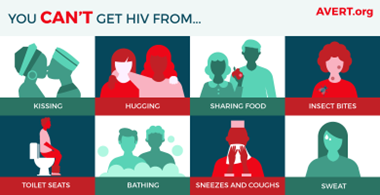
Kissing, shaking hands and hugging or sharing toilet seats, swimming pools, cups, cutlery, etc is all fine!
Remember HIV can only be passed on if blood, semen, fluids from the vagina or breast milk gets into the other person’s body. And only if that person is not on effective treatment.
You are at higher risk if you have another STI or open cuts or ulcers as it easier for the virus to get into your body.
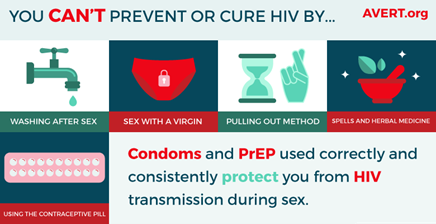
There are lots of urban rumours about ways that you can protect yourself from HIV – from showering after sex or taking the contraceptive pill to having sex with a virgin. If you are having sex the only methods of HIV prevention which will protect you from HIV are condoms, pre-exposure prophylaxis (PrEP) or post-exposure prophylaxis (PEP).
Myth!
HIV is not always passed on from an infected person. There are lots of reasons why this is the case. For example, if the person living with HIV is on treatment it will reduce the amount of HIV in their body meaning it is unlikely to be passed on.
Myth!
Like most illnesses, HIV doesn’t discriminate between types of people and the infection can be passed on to anyone.
Some people are more vulnerable to HIV infection if they engage regularly in certain activities (e.g. injecting drugs) that are more likely to transmit the virus. However, it’s a common misunderstanding that HIV only affects certain groups.
Myth!
The symptoms of HIV can differ from person-to-person and some people may not get any symptoms at all. Without treatment, the virus will get worse over time and damage your immune system. You cannot tell by looking at someone if they have HIV. Many people don’t show any signs or symptoms. And, for people living with HIV who are on effective treatment, they are just as likely to be as healthy as everyone else.
Myth!
If you have an undetectable viral load then there is no risk to your partner. You should only tell them about your status if you feel ready and safe to do so. If this is never, then that is OK.
It is a bit more complicated if you are not on treatment or you know you have a detectable viral load.
Since 2001, there have been prosecutions for the “reckless transmission” of HIV in the UK. There are two laws which are relevant here:
Culpable and Reckless Conduct – could be used if you knew the risk of
passing HIV on but did not take any action to protect or lessen the
impact on the other person (e.g. condoms, advising them to access PEP).
Assault Laws – could be used if there is evidence that a person
intentionally set out to transmit HIV to another person (this has
never actually been used in the UK).
The problem with this is that it has not reduced HIV transmission. Instead, it has undermined public health by increasing stigma, victimisation and discrimination of people living with HIV. Investigations are often long and protracted and spark stigmatising media coverage.
Myth!
People LWHIV who wish to be mothers are supported to do so.
If you are on effective treatment and have an undetectable viral load – the risk of HIV being passed on to the baby is just 0.1%.
Even if you test positive during your pregnancy, we can get you started on treatment very quickly and risk to baby is tiny.
If you’re pregnant LWHIV you’ll get a little extra support and monitoring, including changing your ARVs to those safer in pregnancy, checking your VL, offering PEP to baby, support with infant feeding. As well as your midwife, you’ll be cared for by an obstetrician, paediatrician and HIV specialist.
Myth!
Unfortunately, in the past that was the case.
Nowadays, we have modern treatments that are simpler with far fewer side effects. They are also designed to prevent drug resistance.
Many people just take one tablet once a day. Some people get their treatment in the form of an injection every couple of months.
Although there is no cure for HIV, the treatment is highly effective. The most important things are that the person takes the medication as prescribed and avoids mixing it with other medications which have interactions. Problems occur if the person regularly misses doses or takes their treatment late. Support is available to help with this.
Fact!
On effective treatment, people with HIV can expect to live as long as their peers without HIV.
Some research also suggests your health outcomes could be better as you get regular health check-ups throughout your life, including extra screening and interventions for heart disease, bone health and cancers, such as cervical cancer.
If people are diagnosed late, it can be harder for their immune system to recover. This is why testing is so important.
Fact!
HIV treatment aims to reduce the amount of virus circulating in your body to an undetectable level. When at this undetectable level (< 200 copies per ml), the virus cannot be passed on.
Absolutely!
Effective HIV treatment means most people diagnosed nowadays with HIV are able to work just like everyone else and it is in fact illegal to discriminate against someone in recruitment or employment because they are living with HIV.
Myth!
Some people do and that’s great, however, HIV related stigma is still a significant problem#.
HIV is treated as a disability under the Equality Act 2010 meaning they should be protected. However, people still face discrimination, violence and harassment.
It may not be safe for someone to disclose their status and people also experience a lot of self-stigma.
Also why should someone be open about their HIV status? Do we expect people to share their other health conditions with other people?
Myth!
Despite sometimes being talked about in the media, there is no evidence for this myth—commonly referred to as HIV-related ‘health-tourism’. In fact, the evidence shows that most migrants with HIV who come to the UK do not know they have it before they arrive (and are not diagnosed for several years) so are definitely not coming over here seeking treatment.
Myth!
Not only can patients with hepatitis C be treated, they can also be cured. Today, there are more treatment options than ever before. “Cured” means that the hep C virus is not detectable in your blood 3 months after treatment has ended.
If you have ever had hepatitis C, your blood will always contain hep C antibodies and antibody tests will always show up as positive or reactive however this does not mean you are infectious. A further test called a PCR test is required to show if the virus is currently active in your blood.
Myth!
The newest treatments are a course of tablets taken over 8 – 12 weeks with very few side effects. The older treatments for hep C involved weekly injections of interferon for up to a year; with lots of side effects but this treatment is a thing of the past.
Myth!
Though it’s rare, you can get hep C through sexual contact. This is more likely to occur in men who have sex with men where bleeding occurs such as during anal or rough sex or when a woman has their period.
Myth!
There is not currently a hepatitis C vaccine. Vaccines are only available for hepatitis A and B.
© 2026 Sexual Health Tayside | NHS Tayside -